In cells, hydrogen reduced the hydroxyl radical but did not react with other oxygen species, and breathing hydrogen gas reduced brain injury in rats.
Hydrogen,
explained
What it is, what research in people actually shows, and how strong the evidence is. Every study is linked, so you can read it yourself.
The smallest molecule there is
Molecular hydrogen (H₂) is two hydrogen atoms joined together. It is a gas, and it dissolves in water. Hydrogen water is simply water with this gas dissolved in it, measured in parts per million (ppm). 1 ppm means 1 milligram in a litre.
2 atoms
The smallest, lightest molecule there is.
No taste
It dissolves in water without changing the taste.
Escapes fast
Once a container is open, it starts to leave.
A selective antioxidant
Free radicals are reactive molecules. Some damage cells; others carry useful signals. In a landmark 2007 study, hydrogen reacted with the most damaging one and left the useful ones alone. This comes from cell and animal research, and how it works in people is still being studied.
The review describes hydrogen as acting both by reacting with strong oxidants and indirectly by changing gene expression, with most evidence from animal studies and clinical studies still under way.
What studies in people show
We read the studies so you don’t have to, including the ones that found nothing. Each topic shows how strong the evidence is. Tap a topic to see its studies.
Research suggests hydrogen-rich water may make hard exercise feel a little easier, lower blood lactate and help power hold up in repeated efforts. Effects are small; pooled studies do not show better endurance or strength overall, and several well-run trials found no difference.
Hydrogen water prevented a rise in blood lactate and an early drop in muscle power, but did not change blood markers of oxidative damage or muscle damage.
With hydrogen water, lunges were done faster, lactate was lower and muscle soreness 24 hours later was lower than with placebo.
Hydrogen water before running made no difference to time to exhaustion, lactate, heart rate or oxygen uptake.
Hydrogen had small effects on leg explosive power, perceived effort and blood lactate, but no meaningful effect on aerobic endurance, anaerobic endurance or strength.
Hydrogen did not lower a marker of exercise-induced oxidative stress, but slightly raised a marker of antioxidant capacity; the authors call for more rigorous studies.
600 mL of hydrogen water within 30 minutes before exercise lowered blood lactate at higher intensities, and exercise felt easier, compared with placebo.
Hydrogen water just before exercise lowered feelings of fatigue after mild exercise; in trained people, endurance (maximal oxygen uptake) and perceived effort improved.
Sprint times in the last sprints of a 15-sprint test were 2 to 3% faster with hydrogen water; lactate and perceived effort did not differ from placebo.
Average power held up better across repeated cycling sprints, heart-rate variability recovered faster and lactate was about 1 mmol/L lower 3 minutes after, compared with placebo.
After 8 days of hydrogen water, total power and repetitions in a squat endurance test were higher than with placebo; jump height, recovery scores and soreness over 48 hours did not differ.
A single 500 mL drink did not change peak oxygen uptake, but two weeks of daily hydrogen water raised it, with no change in lactate or oxidative stress markers.
Four days of hydrogen water improved a 400 m time trial by 0.6%, but not sprint times, lactate, perceived effort or an oxidative stress marker.

Research suggests hydrogen-rich water may reduce muscle soreness and blood markers of muscle damage after hard training, and help heart rate settle sooner. The trials are small, mostly in athletes, and one found no effect on soreness.
With hydrogen water, lunges were done faster, lactate was lower and muscle soreness 24 hours later was lower than with placebo.
12 hours after two hard sessions in one day, a muscle damage marker (creatine kinase) and muscle soreness were lower, and jump height higher, with hydrogen water than placebo.
Strength improved in both groups, but blood markers of muscle damage after resistance exercise fell more with hydrogen water than with control water.
Hydrogen water lowered a muscle damage marker (creatine kinase) and raised peak torque after intense exercise; scores on a stress and recovery questionnaire did not change.
After 7 days of hydrogen water, rowing power was higher and heart rate fell faster in the 2 minutes after a sprint test than with placebo water.
Research suggests hydrogen-rich water may reduce feelings of fatigue, and small trials found better mood, less anxiety and better self-rated sleep than with plain water. The studies are small and short, so these are early signals, not proof.
After 4 weeks of 600 mL a day, scores on a mood and anxiety questionnaire and resting sympathetic nerve activity were lower with hydrogen water than with placebo water.
Hydrogen had a small effect on perceived exertion and blood lactate during exercise, but did not improve VO2max or endurance performance.
Fatigue scores, walking distance and sleep quality improved more with hydrogen water than placebo, while breathlessness and mood scores did not change.
People who drank hydrogen water 30 minutes before mild exercise rated their fatigue lower than with placebo, most clearly those who felt most tired.
A litre of hydrogen water a day for 8 weeks improved self-rated sleep quality and cravings compared with control water.
Research suggests possible small effects on attention and some markers of ageing, but the evidence is early. A one-year trial in people with mild memory problems found no overall difference from placebo.
After 1 year there was no overall difference in memory test scores between hydrogen water and placebo; only a subgroup carrying the APOE4 gene improved.
Hydrogen water was linked to a small difference in telomere length, some brain metabolite levels and chair-stand performance, with no difference in most other measures including cognitive function.
A single drink of hydrogen water improved performance on two attention tests compared with tap water, similar to a small dose of caffeine.
The authors note that only a handful of human studies exist; they suggest hydrogen may help alertness, executive function and memory, but say more trials are needed to confirm it.
Research suggests hydrogen-rich water may raise antioxidant capacity and calm some inflammation signals in some people. Results are mixed: some trials found no benefit, and one found signs of increased oxidative stress in a subgroup.
After 4 weeks, overall oxidative stress markers did not differ between groups, but antioxidant capacity rose more in people aged 30 and over, and inflammation-related gene activity in blood cells was lower with hydrogen water.
Hydrogen water did not change exercise performance, but helped keep blood antioxidant capacity from falling over 3 days of hard exercise.
Drinking 4 to 5 ppm hydrogen water for 4 weeks was followed by a 14% fall in a urine marker of oxidative DNA damage; without a placebo group the result is hard to interpret.
Hydrogen water raised one antioxidant marker but also raised a marker of oxidative damage, and the authors concluded it did not reduce oxidative damage.
After 8 weeks, an inflammation marker (IL-6) was lower straight after a maximal exercise test than in the control group; the authors caution that the groups differed at the start.
Alongside less muscle damage, an anti-inflammatory signal (IL-10) and vitamin E rose with hydrogen water.
Research suggests hydrogen-rich water may slightly lower total and LDL cholesterol in adults with metabolic risk factors. A 2026 review of 13 trials found the changes were small and below what doctors consider meaningful for heart risk.
Hydrogen water lowered modified LDL, small dense LDL and a urine oxidative stress marker; the oral glucose test normalised in 4 of 6 people with impaired glucose tolerance.
Over 8 weeks an antioxidant enzyme rose, a urine oxidative stress marker fell and HDL rose 8% by week 4, with no change in fasting glucose.
After 10 weeks of hydrogen water, total and LDL cholesterol were lower and lab tests of HDL function improved.
Compared with placebo, 24 weeks of high-concentration hydrogen water lowered cholesterol, glucose and HbA1c and improved inflammation and redox markers, with a trend to slightly lower BMI.
Hydrogen water lowered total cholesterol by about 6.7 mg/dL and LDL by about 3.2 mg/dL, slightly lowered HDL, and did not change triglycerides; the authors judged these changes too small to justify use as a cholesterol treatment.
We found no controlled trial showing that drinking hydrogen water improves skin. The small studies that exist used hydrogen water baths or applied it to the skin, and most had no comparison group.
In skin cells hydrogen water raised collagen production and reduced UV damage; daily hydrogen baths for 3 months improved neck wrinkles in 4 of 6 people.
Applying hydrogen water to the skin for 4 weeks was followed by smaller-looking pores, but the study had no control group.
Facial skin features were measured, and drinking hydrogen water for 6 months made no significant difference to them compared with control water.
Reviews show a large and growing body of hydrogen research, but most of it is in animals. They also show that hydrogen gas itself, not alkalinity or 'structured water', is what drives the effects seen in studies.
About three quarters of the 321 articles were in mice and rats, and the authors note the full mechanism is still not understood.
The review concludes that dissolved hydrogen gas, not alkaline pH, 'microclusters' or 'free electrons', explains the effects reported for ionised water.
Early clinical results on exercise, mental health, oxidative stress and more are encouraging, but larger, more rigorous trials are needed before firm conclusions.
Hydrogen is hard to keep
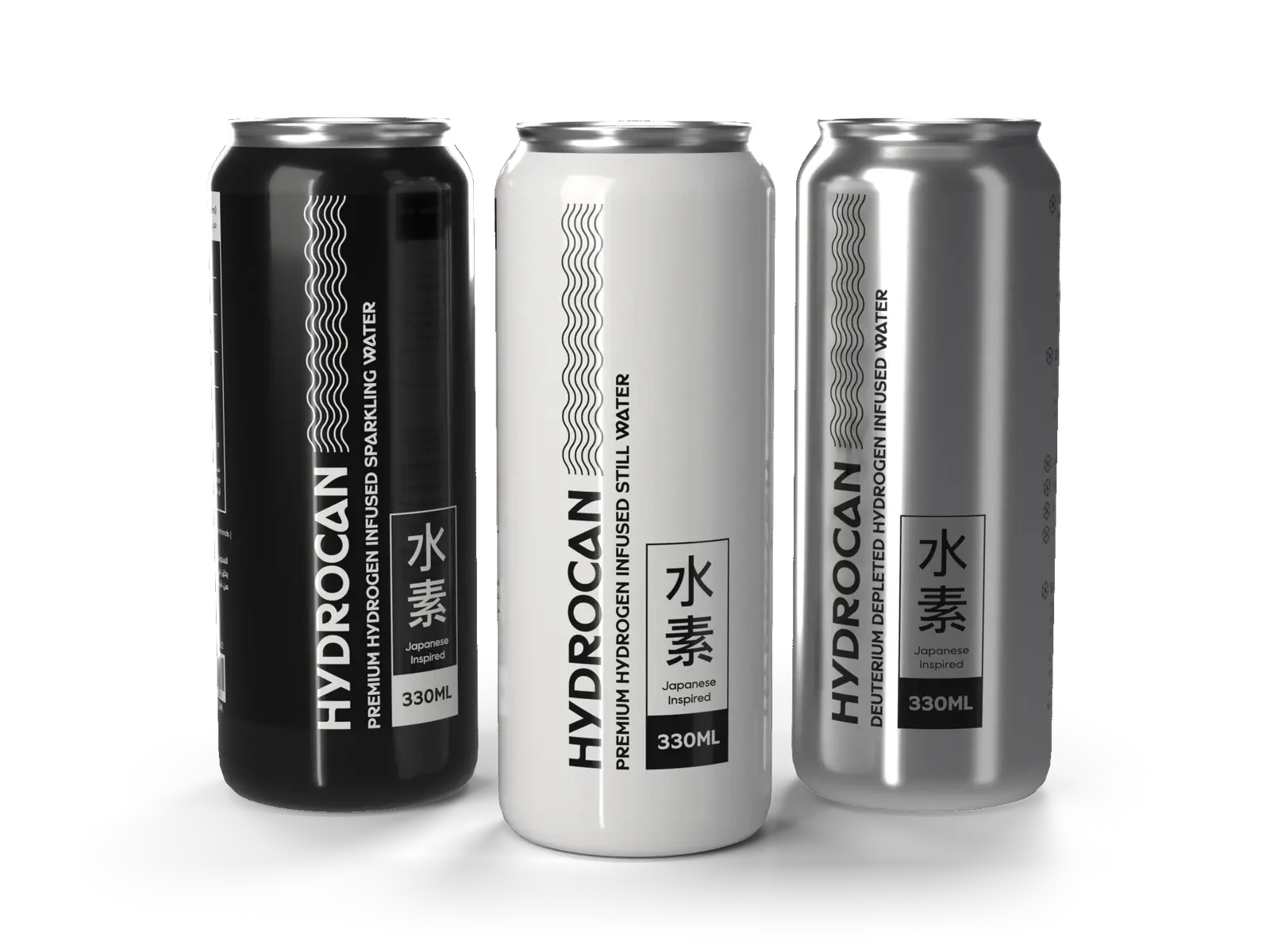
Because it is so small, hydrogen escapes easily. Tests in Japan show how much the container matters, and why to drink it soon after opening. HydroCan is sealed in aluminium. Drink it within one hour of opening.

A different idea, still early
Deuterium is a heavier form of hydrogen found naturally in all water. Deuterium-depleted water has less of it. It is a separate idea from hydrogen water, and most of its research is in cells and animals, so we make no health claims for it. Our Deuterium-Depleted can also carries up to 5 ppm hydrogen.
Evidence: Early researchAfter 90 days of deuterium-depleted water, blood sugar markers improved in 15 people and worsened in the other 15.
The included studies were mixed in design, and the authors say randomised controlled trials are still needed to confirm any cause and effect.
The effects described for deuterium-depleted water come mostly from cell and animal experiments.
What we don’t know yet
- Most hydrogen studies are small, often 10 to 60 people, and many last only days or weeks.
- A large share of hydrogen research is in cells or animals. Results in animals do not always carry over to people.
- Results are mixed. Several well-run trials found no benefit, and reviews find no effect on endurance or VO2max.
- Where reviews find effects, such as on cholesterol or perceived effort, the effects are small.
- Few positive findings have been repeated in large, independent trials.
- Studies used different doses and ways of giving hydrogen, such as water, gas, baths or tablets, so results cannot simply be applied to one product.
- Hydrogen escapes quickly once a container is opened. The amount in your drink depends on packaging, storage and how soon you drink it.
- We found no controlled trial showing that drinking hydrogen water improves skin.
- Deuterium-depleted water is a different product from hydrogen water, and its evidence is mostly from cells and animals.
- These products are not medicines and are not intended to diagnose, treat, cure or prevent any disease. Speak to a doctor if you have a health condition, especially kidney problems or a salt-restricted diet.
Try it for yourself
Up to 5 ppm hydrogen, sealed in aluminium. Free UAE delivery over AED 200.